Practice NCLEX priority questions examples with nurse-led rationales. Learn how to spot instability, safety risks, and the patient who needs you first.
You can know every lab value on the study guide and still freeze when four patients are calling for help at once. That is why NCLEX priority questions examples matter. They force you to stop asking, “What fact do I remember?” and start asking, “Who is least safe right now, and what does this patient need first?”
That is nursing thinking. It is also the skill behind many NCLEX questions, clinical checkoffs, and real shifts. The goal is not to memorize a magic priority list. The goal is to recognize instability, anticipate what can get worse fast, and choose the safest next move.
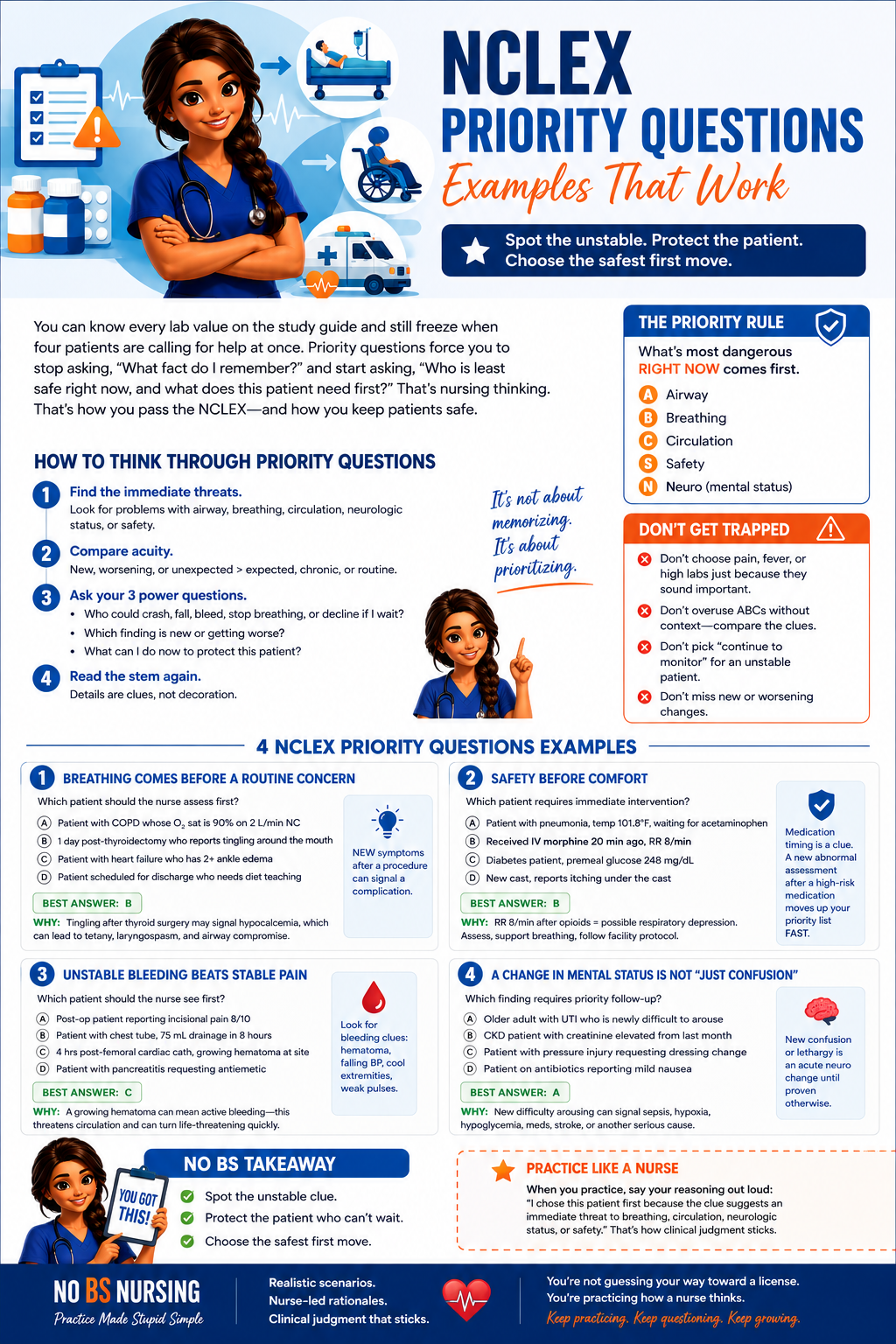
How to Think Through NCLEX Priority Questions
Priority questions often look complicated because every option may be true, appropriate, or worth doing eventually. But NCLEX is usually asking about first, best, most urgent, or highest priority. Those words change everything.
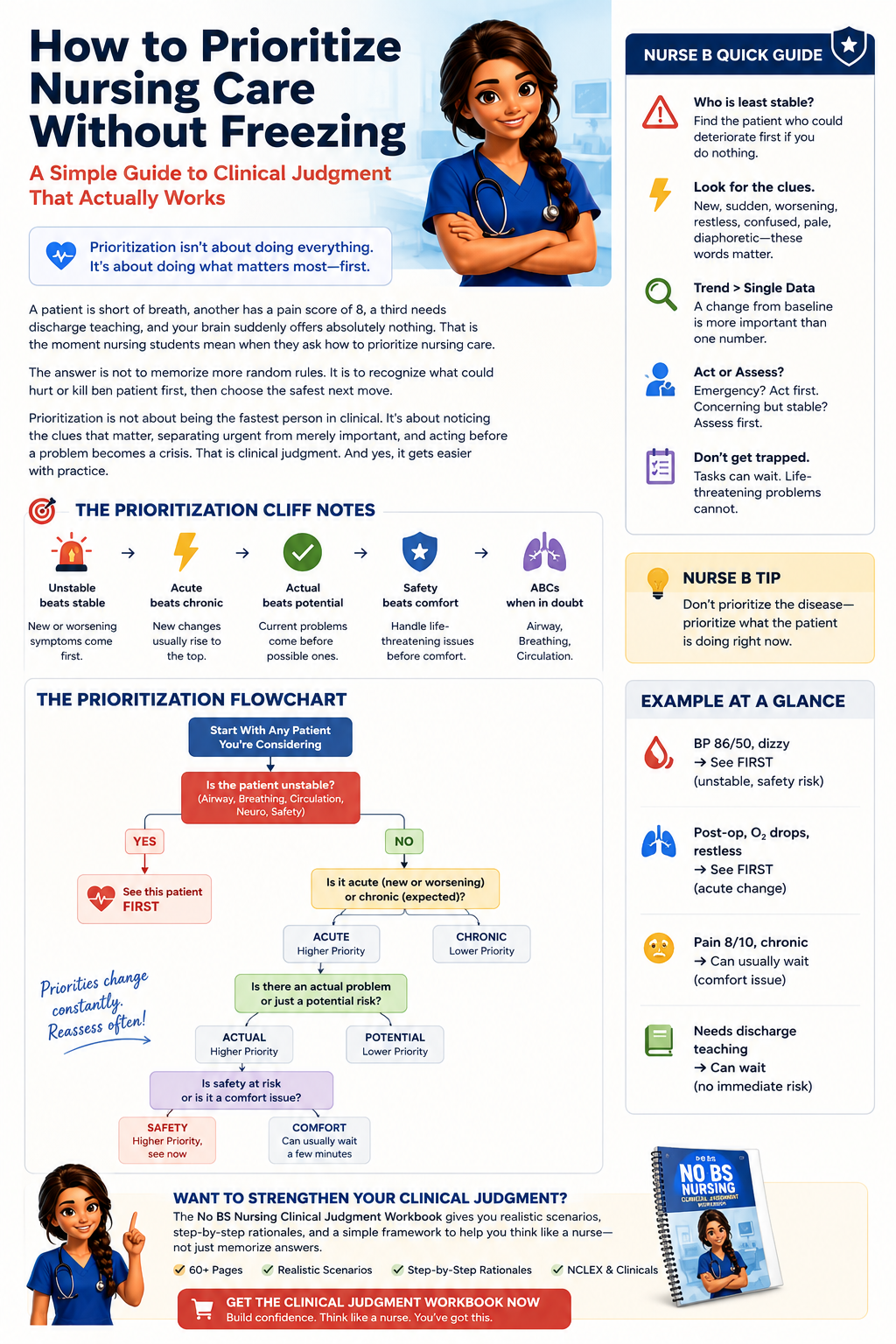
Start by looking for immediate threats to airway, breathing, circulation, neurologic status, and safety. Then compare acuity. A patient with a new, worsening, or unexpected problem generally comes before a patient with an expected finding, a chronic issue, or a routine need.
Use frameworks, but do not use them blindly. ABCs can help when one patient is clearly struggling to oxygenate and another has a less urgent issue. Safety can move ahead of ABCs when a patient is actively trying to get out of bed after sedation or has a rapidly dropping blood glucose. The point is not to chant a mnemonic. The point is to identify the risk that can harm the patient first.
Ask yourself three blunt questions:
- Who could crash, fall, bleed, stop breathing, or decline if I wait?
- Which finding is new or getting worse?
- What can I do now that protects the patient while I get more help if needed?
Then read the stem again. Details are clues, not decoration.
NCLEX Priority Questions Examples With Rationales
Example 1: Breathing comes before a routine concern
Question: The nurse receives report on four patients. Which patient should the nurse assess first?
A. A patient with COPD whose oxygen saturation is 90% on 2 L/min nasal cannula
B. A patient 1 day after a thyroidectomy who reports tingling around the mouth
C. A patient with heart failure who has 2+ ankle edema
D. A patient scheduled for discharge who needs teaching about a low-sodium diet
Best answer: B.
Tingling around the mouth after thyroid surgery may signal hypocalcemia related to accidental parathyroid injury. Hypocalcemia can progress to tetany, laryngospasm, and airway compromise. This is not a “wait and see” clue.
Option A may grab your attention because it mentions oxygen saturation, but a saturation of 90% can be an expected target for some patients with COPD. Do not automatically prioritize a number without comparing it to the patient’s condition and baseline. Option C needs assessment, but ankle edema is not the most immediate threat in this group. Option D matters, just not before potential airway trouble.
What to learn: New symptoms after a procedure can signal a complication. Expected versus unexpected matters.
Example 2: Do not walk past an active safety risk
Question: The nurse is caring for four patients. Which patient requires immediate intervention?
A. A patient with pneumonia who has a temperature of 101.8 F and is waiting for acetaminophen
B. A patient who received IV morphine 20 minutes ago and has a respiratory rate of 8/min
C. A patient with diabetes whose premeal glucose is 248 mg/dL
D. A patient with a new cast who reports itching under the cast
Best answer: B.
A respiratory rate of 8/min after IV opioid medication suggests respiratory depression. This is an immediate breathing problem. Assess the patient, stimulate as appropriate, support ventilation, and follow your facility protocol for escalating care and administering reversal medication if indicated.
Fever, hyperglycemia, and itching need nursing action, but none are more urgent than a patient whose breathing may be suppressed. This is a clean example of why “the patient who looks sickest” is not always the answer. The patient with the most dangerous current clue is.
What to learn: Medication timing is a clue. A new abnormal assessment after a high-risk medication should move up your list fast.
Example 3: Unstable bleeding beats stable pain
Question: Which patient should the nurse see first?
A. A postoperative patient reporting incisional pain of 8 out of 10
B. A patient with a chest tube who has 75 mL of drainage over the last 8 hours
C. A patient 4 hours after a femoral cardiac catheterization with a growing hematoma at the insertion site
D. A patient with pancreatitis who requests antiemetic medication
Best answer: C.
A growing hematoma after femoral catheterization can mean active bleeding. That threatens circulation and can become life-threatening quickly. The nurse should assess the site, apply pressure according to protocol, monitor vital signs, and notify the appropriate provider or rapid response team based on the patient’s condition.
Pain and nausea are real needs. Do not dismiss them. But priority is about sequence, not caring more about one patient than another. A stable patient in pain can usually wait a few minutes while you address possible hemorrhage.
What to learn: Look for circulation problems hiding in procedural details: bleeding, cool extremities, weak pulses, falling blood pressure, and changing mental status.
Example 4: A change in mental status is not “just confusion”
Question: The nurse is assigned four patients. Which assessment finding requires priority follow-up?
A. An older adult with a urinary tract infection who is newly difficult to arouse
B. A patient with chronic kidney disease whose creatinine is elevated from last month
C. A patient with a pressure injury who requests a dressing change after breakfast
D. A patient taking an antibiotic who reports mild nausea
Best answer: A.
New difficulty arousing is a major change in neurologic status. It could reflect sepsis, hypoxia, hypoglycemia, medication effects, stroke, or another serious cause. Assess first. Start with immediate data such as airway, breathing, circulation, oxygen saturation, vital signs, and glucose as clinically appropriate.
The phrase “newly difficult to arouse” is doing the heavy lifting here. Chronic abnormal findings are not automatically harmless, but a new decline gets priority until you know why it is happening.
What to learn: Do not normalize sudden confusion, lethargy, or behavior change because a patient is older. Acute mental-status changes are clinical clues.
Common Priority Traps That Cost You Points
The biggest trap is choosing the option that sounds most familiar. Nursing students often pick pain, fever, or a high lab value because those problems are easy to recognize. But the question is not asking which finding is most memorable. It is asking what is most dangerous right now.
Another trap is overusing ABCs without context. For example, a patient with chronic COPD and an oxygen saturation at their baseline may not come before a patient with stridor after a procedure. Compare the actual clues. Numbers need a story.
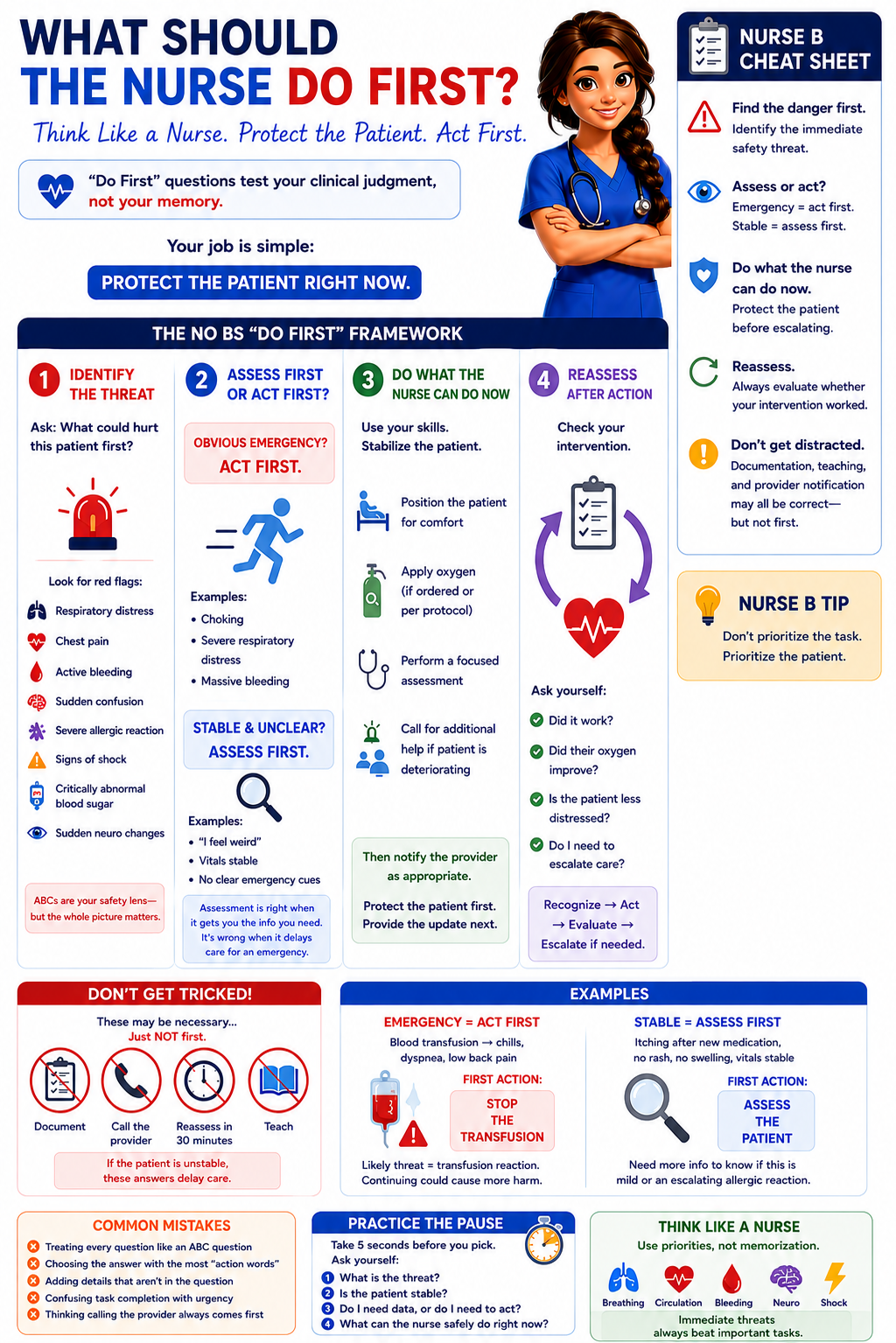
Also watch for the difference between assessment and action. If the patient is unstable, do not select a vague option like “continue to monitor.” If the patient is stable but the cause of a problem is unclear, assessment may be the correct first move. You cannot fix what you have not assessed, but you also do not delay emergency support for a patient who is clearly crashing.
A Fast Method for Practice Questions
When you practice priority questions, do not just check whether you got the answer right. Say your reasoning out loud or write one sentence: “I chose this patient first because the clue suggests an immediate threat to breathing, circulation, neurologic status, or safety.”
If you miss a question, do not label yourself bad at prioritization. Find the missed clue. Was it a new symptom? A medication effect? A postoperative complication? A worsening trend? That feedback loop is how you build clinical judgment instead of collecting random rationales.
No BS Nursing teaches this skill through realistic scenarios because that is how it sticks: see the clue, name the risk, choose the first move, and learn from the rationale. Practice it enough, and priority questions stop feeling like trick questions.
The next time an NCLEX item gives you four patients, slow down. Find the unstable clue. Protect the patient who cannot safely wait. Then choose wisely. You are not guessing your way toward a license. You are practicing how a nurse thinks.