A patient has new shortness of breath, an oxygen saturation of 86%, and crackles in both lungs. Another answer choice says to call the provider. Another says to document the finding. Another says to reassess in 30 minutes. This is why “what should the nurse do first” questions can make your brain freeze. All the options may sound like things a nurse could do. Your job is to choose the action that protects the patient right now.
That is not a memorization problem. It is a clinical judgment problem.
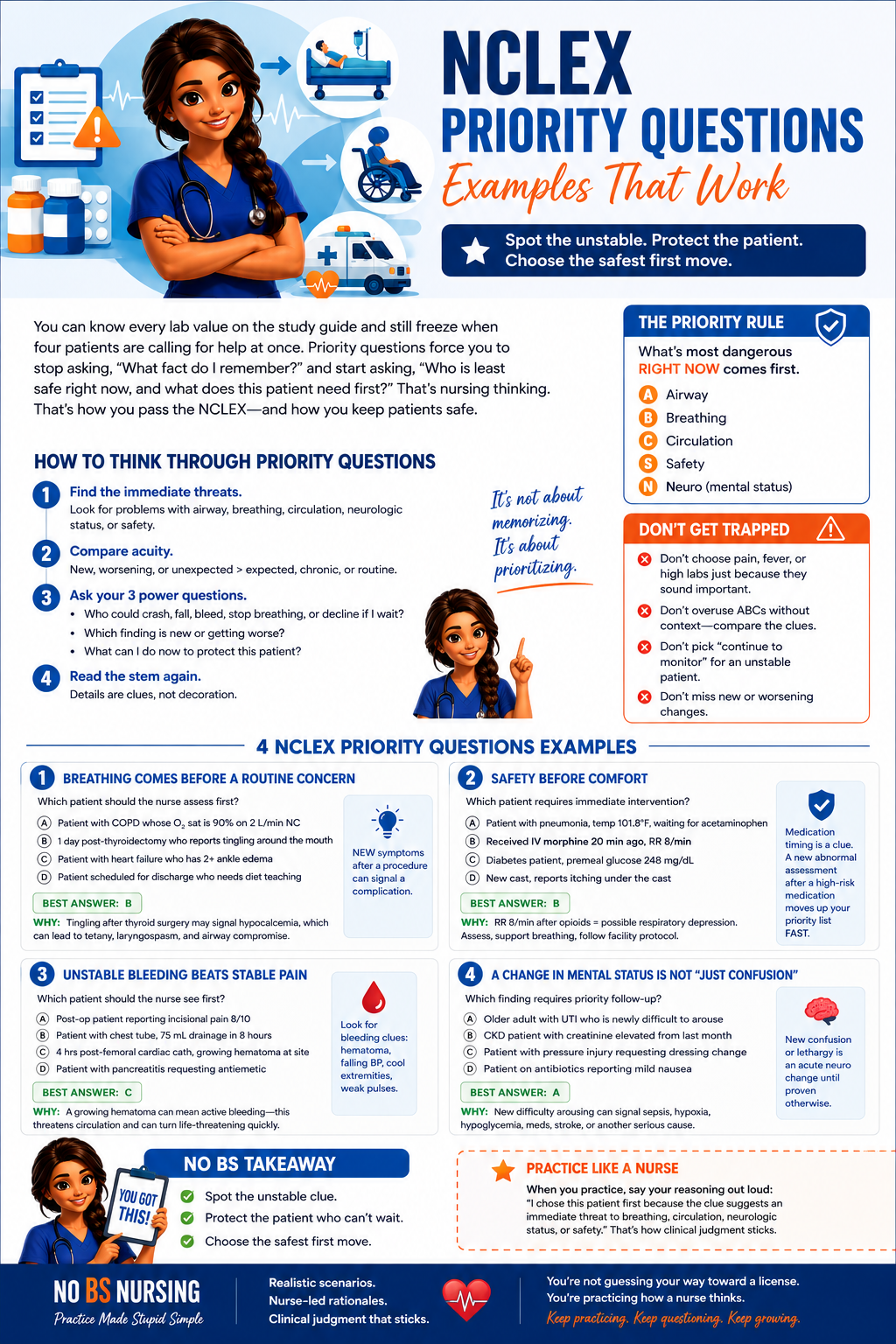
On NCLEX-style questions and in real patient care, “first” means: What action best addresses the most immediate safety threat with the information you have? It does not automatically mean pick the most dramatic action, follow a random acronym, or call the provider every time something is wrong. Think like a nurse. Notice the danger, decide what cannot wait, then act within your role.
🩺 What “Do First” Questions Are Really Testing
These questions test whether you can sort through competing priorities without getting distracted by details. The exam is asking whether you can recognize an unstable patient, separate an urgent problem from a routine one, and choose an intervention that makes sense before you escalate or move on.
The phrase “do first” changes the question. You are not being asked what is the best long-term plan, what should be documented, or what intervention might happen eventually. You are being asked for the next safest move.
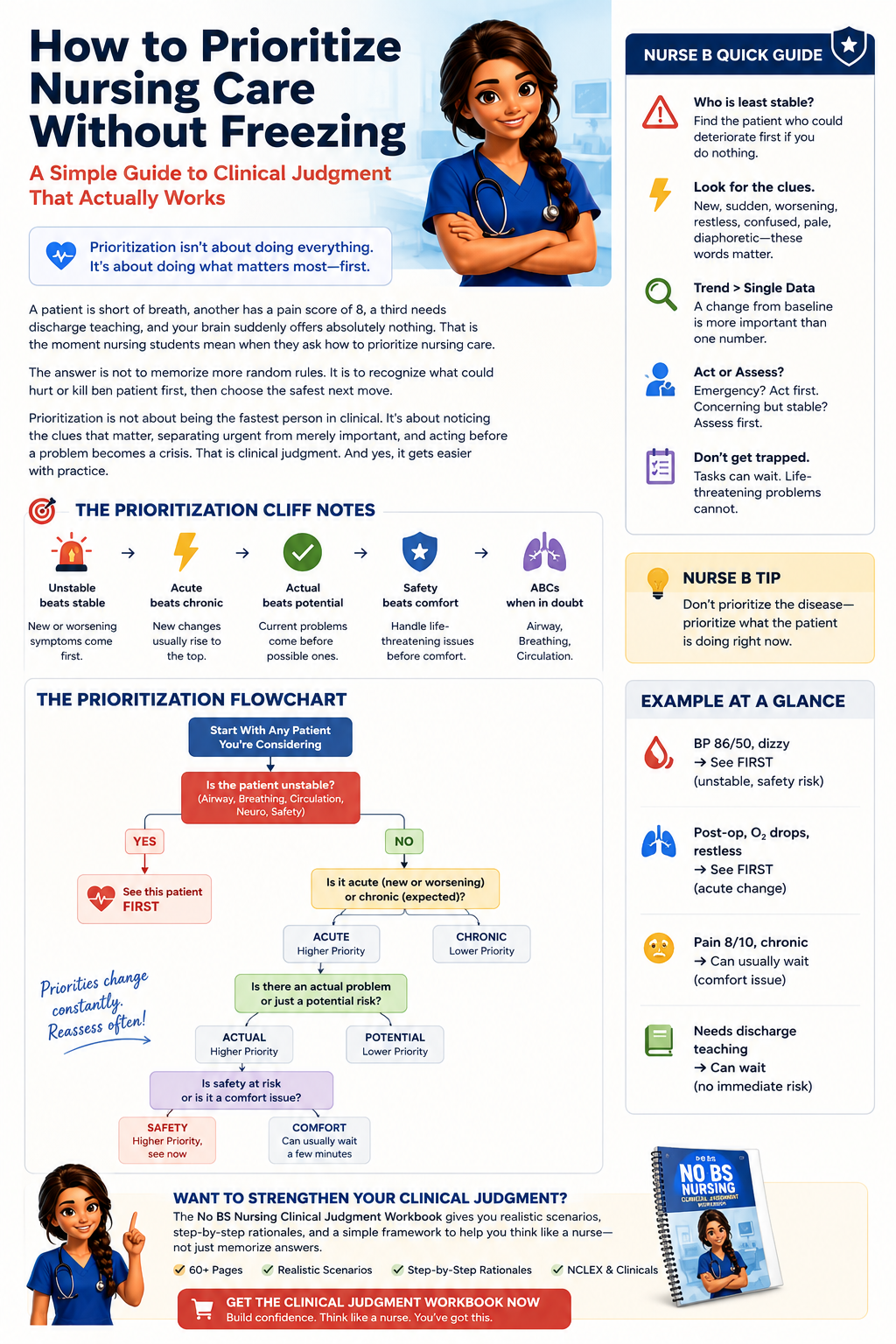
A useful rule is this: immediate threats beat important tasks. A patient who cannot breathe safely comes before a patient who needs education. Active bleeding comes before a scheduled medication. New confusion in a postoperative patient comes before completing the admission database.
But do not turn that rule into a robotic checklist. A stable patient with a chronic low oxygen saturation is different from a patient whose saturation suddenly dropped from 98% to 86%. The change, the context, and the patient’s symptoms matter.
Use This First-Action Framework
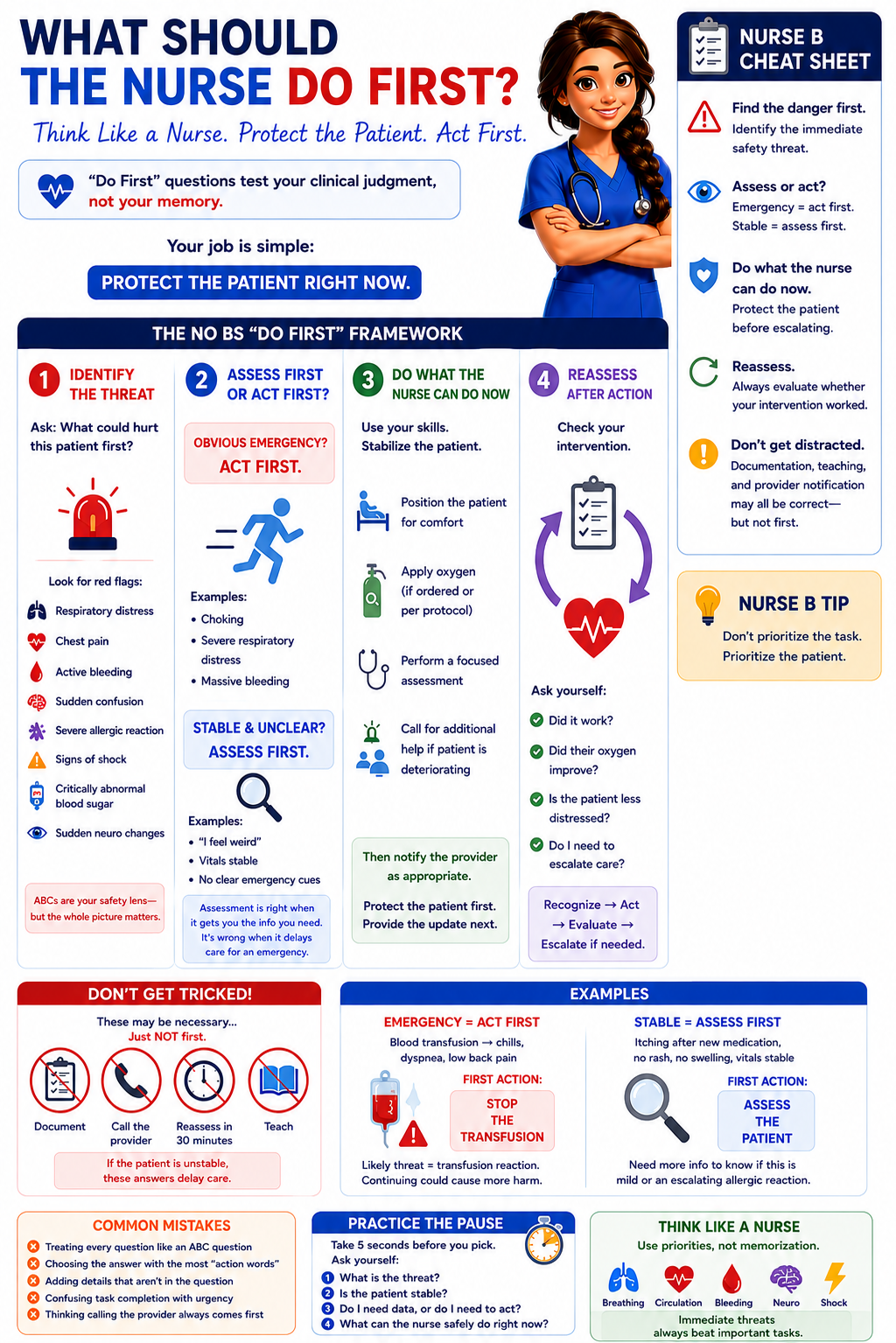
When you see a priority question, slow down for a few seconds and run the options through a simple sequence: identify the threat, decide whether you need more data, act within your scope, and reassess.
| Step | Ask Yourself |
|---|---|
| 1. Identify the threat | 🚨 What could hurt this patient first? |
| 2. Assess or act? | ⚡ Emergency = act. Stable and unclear = assess. |
| 3. Act within your role | 🛡️ What can the nurse safely do right now? |
| 4. Reassess | 🔁 Did the intervention work? |
1. Identify the actual threat
Start with the stem, not the answer choices. Ask: What could hurt this patient first if nobody intervenes?
Look for red flags such as respiratory distress, a declining level of consciousness, chest pain with concerning symptoms, active hemorrhage, severe allergic reaction, signs of shock, a critically abnormal glucose level, or sudden neurologic changes. These clues usually matter more than a mild lab abnormality, a routine complaint, or a task that is merely due.
Use ABCs — airway, breathing, circulation — as a safety lens, not a magic answer generator. Airway obstruction is usually more urgent than breathing difficulty, and breathing problems are often more urgent than circulation problems. But a patient with massive bleeding may be in more immediate danger than a patient with mild, unchanged wheezing. Read the whole picture.
2. Decide: assess first or intervene first?
This is where many students lose points. They hear “assess before you act” and choose assessment even when the patient obviously needs immediate help. Then they hear “act fast” and choose an intervention when they do not yet know what is happening.
Here is the no-BS version: if the patient has an obvious, life-threatening problem, intervene first. If the patient is stable and the cause is unclear, assess first.
For example, if a patient is choking, you do not begin with a full assessment. You intervene. If a patient says, “I feel weird,” has stable vital signs, and no clear emergency cue, further assessment may be the right first move.
On exams, assessment is often correct when it gives you information needed to choose a safe intervention. It is not correct when it delays care for an unmistakable emergency.
3. Choose the action the nurse can do now
Do not automatically call the provider just because the patient looks bad. Nurses are expected to initiate appropriate independent actions, use standing protocols when available, and stabilize the patient while getting help.
For a hypoxemic patient in respiratory distress, actions like positioning upright, applying oxygen as prescribed or per protocol, and rapidly assessing respiratory status may come before notifying the provider. Calling for help may also be immediate if the patient is deteriorating. The exact best answer depends on the choices given and the setting described.
Provider notification becomes the priority when you have assessed the issue, completed appropriate immediate nursing actions, and need a new order or higher-level intervention. Reporting a problem without doing the urgent nursing care you can safely do is often not the strongest answer.
Also watch for questions involving delegation. If a task requires assessment, teaching, evaluation, clinical judgment, or care of an unstable patient, it stays with the RN. A “first” question may be testing whether you recognize that you cannot delegate your way out of a safety decision.
4. Reassess after the action
Nursing care is not one action and done. After you intervene, you check whether it worked. Did the oxygen saturation improve? Is the patient less distressed? Did the blood pressure respond? Has the pain changed?
Reassessment may not be the first answer in every question, but it is always part of good nursing thinking. The nurse’s loop is simple: recognize the cue, act, evaluate the response, and escalate if needed.
How to Read the Answer Choices Without Getting Tricked
Test writers love answers that are technically true but mistimed. Documentation is necessary. Education is necessary. Calling the provider is often necessary. Reassessing can be necessary. The question is whether that action comes first for this patient.
Cross out choices that delay care when the patient is unstable. Be cautious with answers that sound passive, such as “continue to monitor” or “reassess in one hour,” when the stem gives you a new decline. A new change is not routine until you have evidence that it is benign.
Then compare the remaining options. Choose the least invasive action that directly addresses the most urgent problem — unless the patient needs an immediate emergency intervention. If two answers both sound safe, ask which one gives the nurse the fastest useful information or the quickest protection from harm.
For example, a patient receiving a blood transfusion develops chills, dyspnea, and low back pain. The first action is not to notify the provider or obtain a urine sample. Stop the transfusion. The likely threat is an acute transfusion reaction, and continuing the blood product could cause more harm.
Now compare that with a patient who reports itching after a new medication but has no rash, swelling, wheezing, or vital-sign changes. Assessment may come first because you need to determine whether this is a mild reaction or an escalating allergic emergency.
Common Mistakes That Make “First” Questions Harder
The biggest mistake is treating every priority question like an ABC question. ABCs matter, but the clinical story matters more. A stable patient with a long-standing breathing issue may not outrank a patient with sudden internal bleeding or a rapidly changing level of consciousness.
Another mistake is picking the answer with the most action words. “Administer,” “notify,” and “activate” can feel decisive. But strong nursing judgment is not about choosing the boldest verb. It is about choosing the right move for the clues you actually have.
Students also get stuck because they imagine details that are not in the question. Do not invent a provider order, an allergy history, an assessment finding, or a worse outcome. Use the data in front of you. If the question says the patient is alert, do not treat them as unresponsive. If it gives a standing order or protocol, use that information.
Finally, do not confuse urgency with task completion. A scheduled medication may be due. A provider may be waiting for an update. A family member may be demanding answers. None of that outranks an immediate patient safety need.
Practice the Pause Before You Pick
Build a five-second pause into every prioritization question. Before selecting an answer, say to yourself: “What is the threat? Is the patient stable? Do I need data, or do I need to act? What can the nurse safely do right now?”
At first, this will feel slow. That is fine. Speed comes after you build the pattern. Practice with realistic scenarios, read rationales closely, and pay attention to why the other options were wrong at that moment. No BS Nursing focuses on this exact habit because knowing facts is not enough when four answers all look familiar.
You do not need to guess what the exam writer wants. You need to notice the patient in front of you, protect the most urgent need, and take the next safe step. Practice that thinking one question at a time. That is how future nurses stop freezing and start choosing wisely.