A patient is short of breath, another has a pain score of 8, a third needs discharge teaching, and your brain suddenly offers absolutely nothing. That is the moment nursing students mean when they ask how to prioritize nursing care.
The answer is not to memorize more random rules. It is to recognize what could hurt or kill the patient first, then choose the safest next move.
Prioritization is not about being the fastest person in clinical. It is about noticing the clues that matter, separating urgent from merely important, and acting before a problem becomes a crisis. That is clinical judgment — and yes, it gets easier with practice.
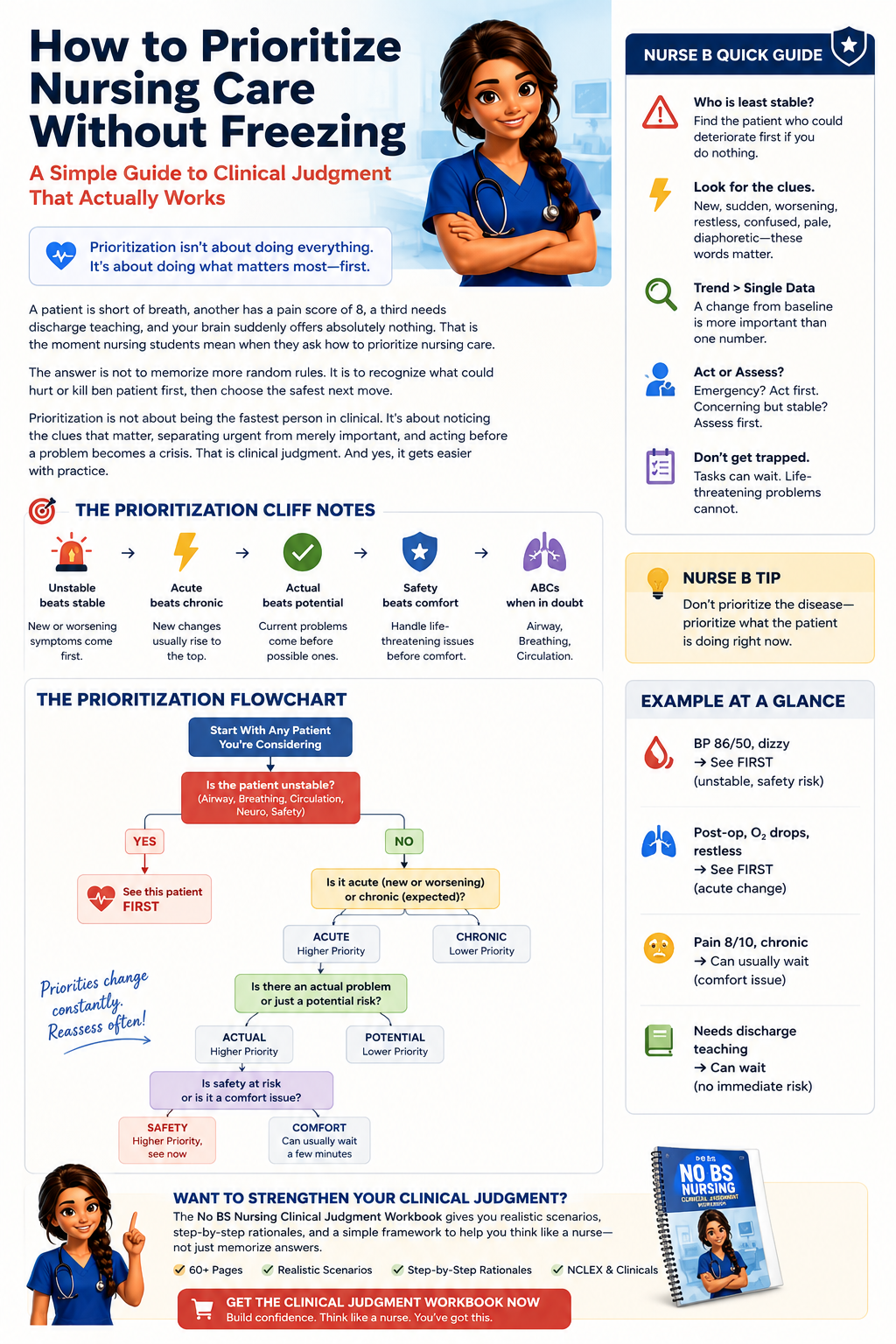
🩺 Nurse B''s Prioritization Cheat Sheet
When you''re stuck, ask yourself these five questions.
| Ask Yourself | Higher Priority |
|---|---|
| Is the patient unstable? | 🚨 Unstable before stable |
| Is this new or worsening? | ⚡ Acute before chronic |
| Is there an actual problem? | ✅ Actual before potential |
| Is safety at risk? | 🛡️ Safety before comfort |
| Is there an ABC issue? | 🫁 Airway → Breathing → Circulation |
Start With One Question: Who Is Least Stable?
Before you get pulled into tasks, medications, or a dramatic diagnosis, scan for instability.
Ask yourself: which patient could deteriorate first if I do nothing right now?
Look for immediate threats to:
- Airway
- Breathing
- Circulation
- Neurologic status
- Patient safety
A patient with stridor, new confusion, active bleeding, crushing chest pain, worsening oxygen levels, or rapidly dropping blood pressure needs attention before the patient waiting for routine discharge teaching.
This sounds obvious on paper. In clinicals and on the NCLEX, it becomes difficult because every patient seems to have a problem. Your job is to recognize which problem has the shortest path to serious harm.
For example, a patient with COPD who is comfortably talking with their usual oxygen saturation is very different from a postoperative patient whose oxygen suddenly drops from 98% to 88% while becoming restless with shallow respirations.
The number matters. The change from baseline matters even more.
Use This Simple Prioritization Filter
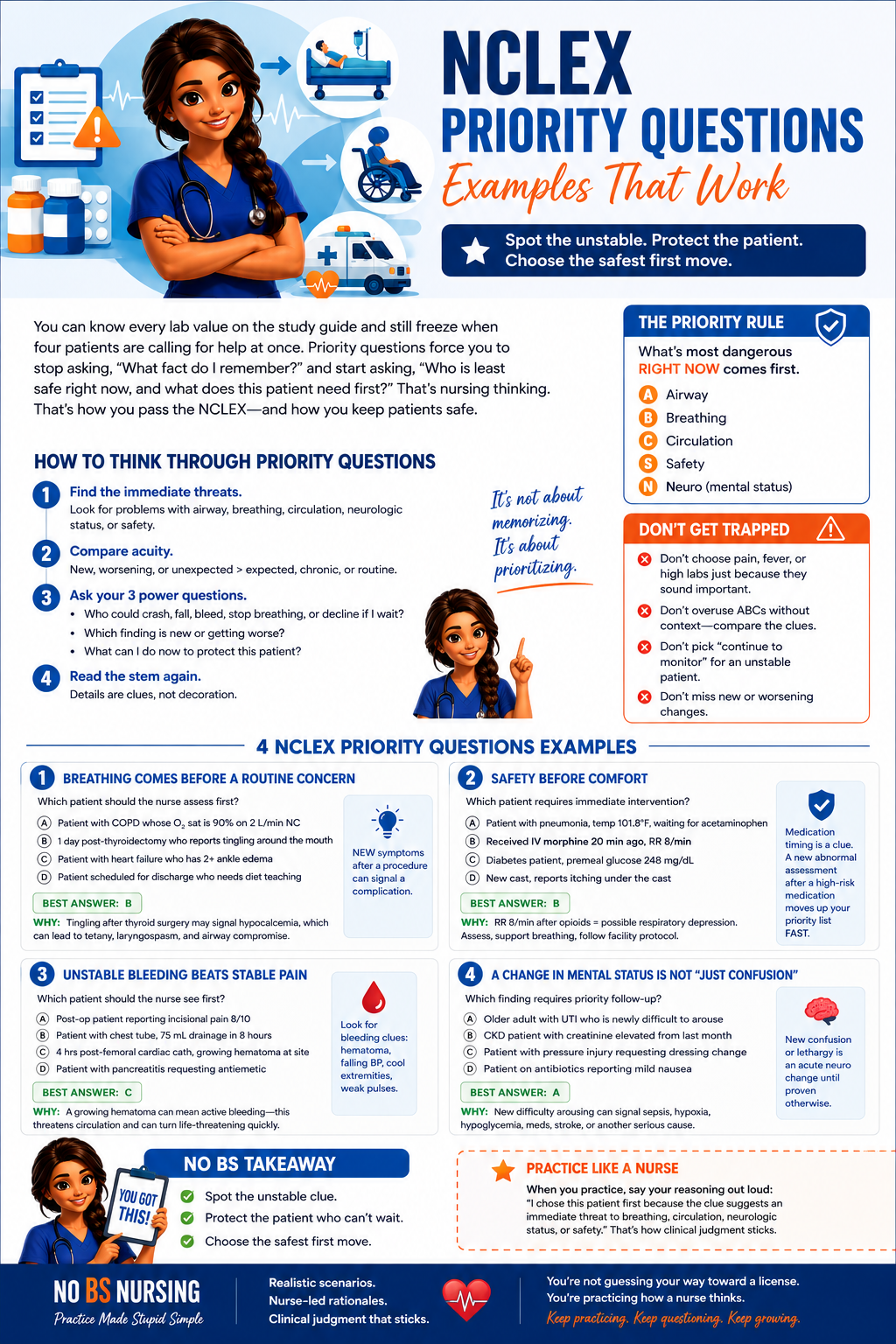
Whenever your brain freezes, think through these four questions.
Unstable Beats Stable
Patients with worsening vital signs, respiratory distress, altered mental status, uncontrolled bleeding, or rapidly changing symptoms almost always move to the top of your priority list.
Stable patients still need care — but they usually have time to wait while you address the emergency.
For example, a patient with chronic heart failure and mild ankle swelling may be stable. A patient with heart failure who suddenly develops crackles, frothy sputum, severe shortness of breath, and anxiety may be developing pulmonary edema.
Those are two completely different situations.
Acute Beats Chronic
Chronic conditions deserve attention. New changes deserve immediate attention.
A diabetic patient needing diet education can wait. A diabetic patient who suddenly becomes sweaty, confused, shaky, and has a blood glucose of 48 mg/dL cannot.
Do not let the diagnosis fool you. Prioritize the assessment findings — not whichever disease sounds scarier.
Actual Beats Potential
Most of the time, an actual problem comes before a possible one.
- Active vomiting comes before teaching about preventing nausea.
- A patient climbing over bed rails comes before reviewing fall prevention.
Safety Beats Comfort
Pain matters. Anxiety matters. Comfort matters. But life-threatening problems come first.
You may need to manage a patient in respiratory distress before administering pain medication to someone with chronic pain. That does not mean comfort is unimportant. It simply means you sequence your care: handle the emergency, communicate with your team, then return to the remaining patients.
Use ABCs Without Becoming a Robot
Airway. Breathing. Circulation. They are foundational for a reason — but they are not the answer to every priority question.
Use ABCs when a patient truly has an airway, breathing, or circulation emergency:
- Stridor beats pain.
- Respiratory distress beats discharge teaching.
- Active hemorrhage beats a routine medication pass.
But don''t force ABCs into every scenario. A patient with a chronic cough and no respiratory distress may not outrank a patient who suddenly becomes confused after a head injury. Context always matters.
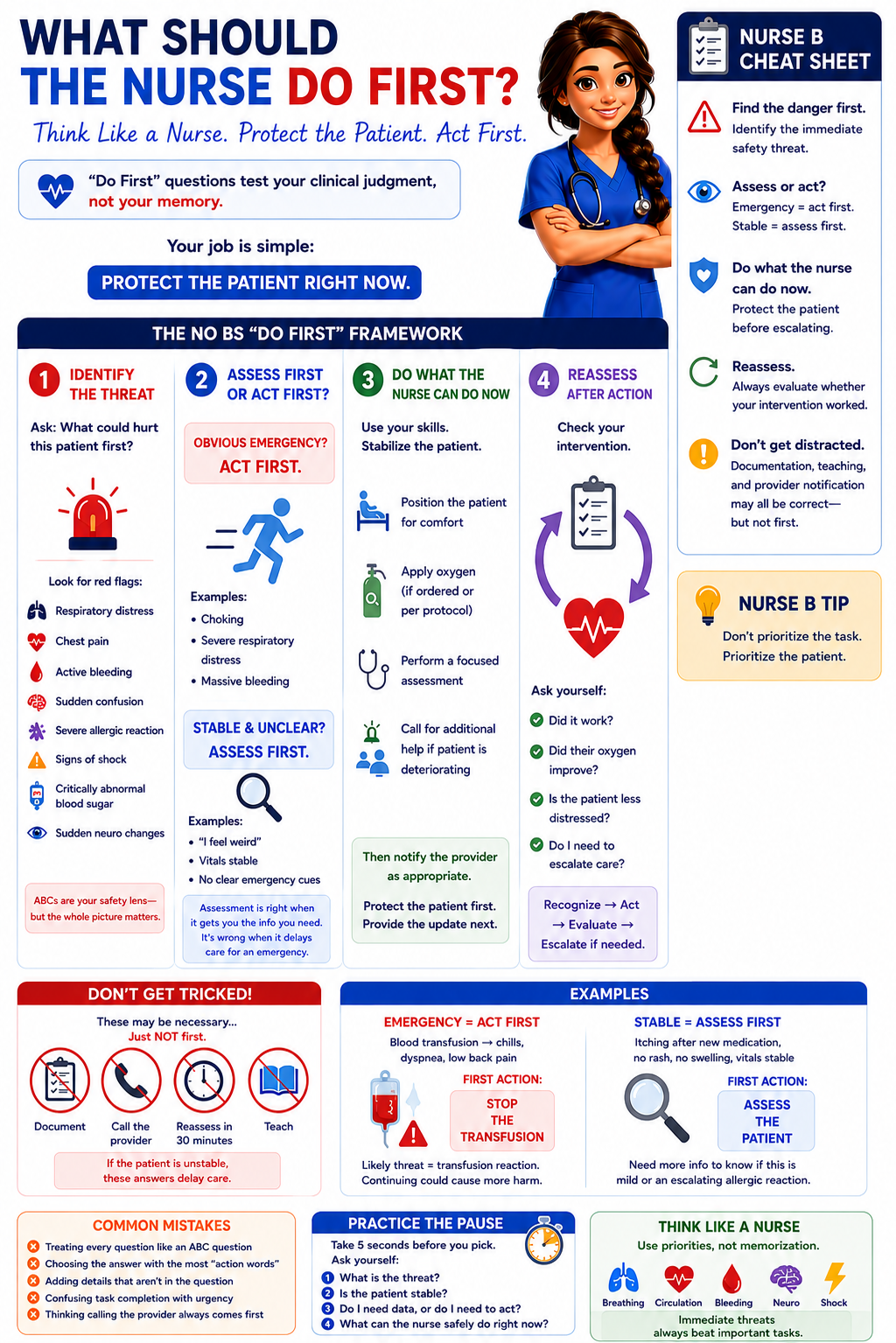
Assess First or Act First?
Students often struggle here. Sometimes you assess. Sometimes you act immediately.
If the patient has an obvious emergency, act first. Examples include:
- Suspected blood transfusion reaction
- Unresponsive patient
- Disconnected chest tube system
- Airway obstruction
In these situations, delaying action could seriously harm the patient.
If the situation is concerning — but not clearly life-threatening — perform a focused assessment first. Examples include:
- New confusion
- New chest discomfort
- Mild oxygen changes
- New weakness
The question isn''t "Do nurses always assess first?" The better question is: "Can this patient safely wait while I gather more information?"
Watch for Priority Clues
Pay attention to words like:
- New
- Sudden
- Worsening
- Restless
- Pale
- Confused
- Unrelieved
- Diaphoretic
These words usually signal that a patient''s condition is changing.
Trend data is also more valuable than one isolated number. A heart rate of 110 after walking may not be alarming. A heart rate climbing from 88 → 110 → 128 while blood pressure falls and urine output decreases tells a very different story.
Don''t Let Tasks Trick You
Everything feels urgent in nursing school. Real nursing is different.
- Changing linens
- Routine documentation
- Scheduled teaching
- Daily weights
Those tasks can often wait while you respond to a deteriorating patient. Once the emergency is addressed, regroup. Delegate when appropriate. Communicate with your team. Then return to your remaining responsibilities.
Practice the Same Five Questions Every Time
Whenever you''re faced with multiple patients, ask yourself:
- What is the worst finding?
- Is it new or expected?
- Could this threaten airway, breathing, circulation, neurologic status, or immediate safety?
- Do I need more assessment?
- Is there an intervention I cannot safely delay?
For example, you have four patients:
- One needs help to the bathroom.
- One reports incisional pain 7/10.
- One has a blood pressure of 86/50 and feels dizzy.
- One needs discharge teaching.
The hypotensive, dizzy patient comes first.
Now imagine the pain patient suddenly develops a rigid abdomen, becomes pale, and starts sweating. Your priorities immediately change. The clues matter.
Build Confidence One Scenario at a Time
You won''t feel calm in every clinical situation right away — and that''s okay.
Confidence doesn''t come from memorizing dozens of prioritization rules. It comes from having a simple process you can rely on when your brain starts spinning.
Practice realistic scenarios. Read the rationale — even when you answer correctly. Ask yourself: "What clue changed the priority?"
Every patient teaches you something. Every scenario sharpens your thinking. One shift at a time, you''ll become faster at recognizing what matters most — and more confident acting on it.
Ready to Strengthen Your Clinical Judgment?
If this article helped you understand how to prioritize nursing care, imagine practicing that same thinking process using realistic patient scenarios with step-by-step rationales.
The No BS Nursing Clinical Judgment Workbook was created to help nursing students stop memorizing random rules and start thinking like nurses.
Inside you''ll find:
- 60+ pages of easy-to-follow content
- Realistic Clinical Judgment & NGN practice questions
- Prioritization scenarios with detailed rationales
- A simple clinical judgment framework you can actually use
- Practical exercises that build confidence for clinicals and the NCLEX
Whether you''re preparing for the NCLEX, building your clinical judgment, or simply tired of second-guessing every answer, this workbook was designed to help you think through patient situations with confidence.
👉 Download the No BS Nursing Clinical Judgment Workbook and start building your confidence today.