You can spend six hours rereading cardiac notes and still freeze when an NCLEX question asks which patient needs intervention first. That is the real issue behind practice questions versus content review. Nursing school does not reward the student who can recognize the most terms on a page. It rewards the student who can spot the clue, connect it to a risk, and choose the safest next action.
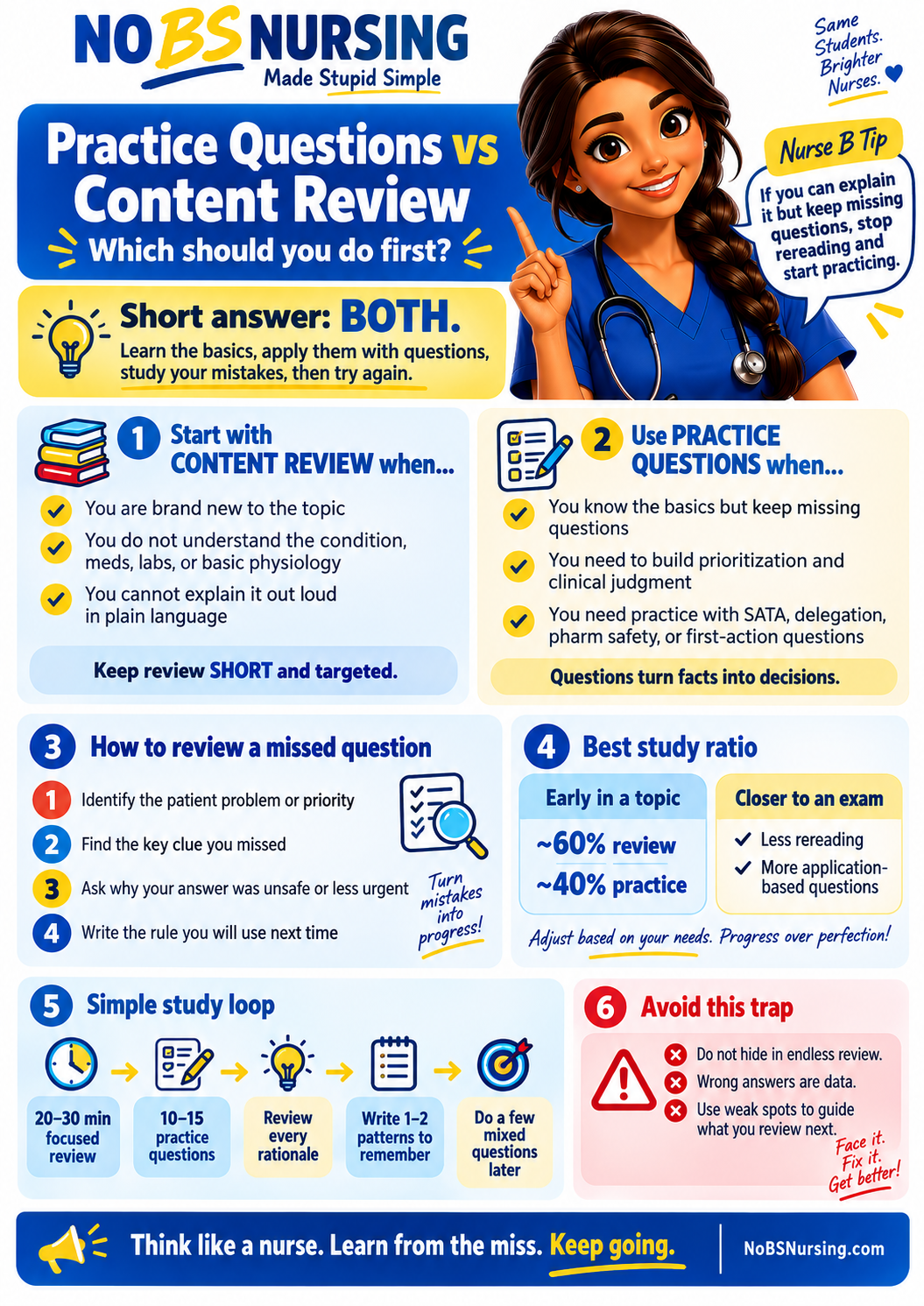
So, which should you do first: review content or answer questions? The no-BS answer is both. But not in equal amounts, and not in the random way most students approach it.
Practice Questions Versus Content Review Is Not an Either-Or Fight
Content review gives you raw material. You need to know what potassium does, why a low oxygen saturation matters, and what signs point to worsening sepsis. You cannot reason through a scenario if the basic facts are missing.
But content review alone can create a false sense of security. Highlighting notes feels productive because everything looks familiar. Familiarity is not the same as recall, and recall is not the same as clinical judgment. On an exam, nobody asks you to highlight the page where acute respiratory distress is discussed. You have to recognize it in a patient whose respiratory rate is climbing, whose oxygen saturation is falling, and who suddenly cannot finish a sentence.
Practice questions expose the gap between “I saw this before” and “I can use this safely.” They force you to make a decision with incomplete information, competing priorities, and answer choices designed to make you second-guess yourself. That is exactly why they matter.
The goal is not to pick a team. The goal is to create a study loop: learn the essentials, apply them, study your mistakes, then apply them again.
Start With Content Review When the Foundation Is Missing
If you are staring at a question and do not understand the condition, medication class, lab value, or basic physiology, more questions are not the fix. You are not failing because you need to “try harder.” You need a short, targeted review.
Use content review first when you are brand new to a topic, such as insulin types, chest tubes, heart failure, or isolation precautions. Review the core purpose, major safety risks, expected findings, and nursing actions. Keep it tight. You do not need to memorize an entire textbook chapter before you practice.
For example, before answering questions about heart failure, make sure you can explain the difference between left-sided and right-sided failure. Know why crackles, dyspnea, edema, daily weights, and worsening oxygen needs matter. Then move into questions quickly.
What Targeted Review Actually Looks Like
Targeted review is specific. It is not opening every resource you own because you missed one question.
Say you miss a question about a patient receiving furosemide. The rationale tells you the key concern is hypokalemia. Do not spend the next two hours rereading all diuretics, all cardiac drugs, and every fluid-and-electrolyte chapter. Review potassium’s role, the signs of hypokalemia, relevant ECG concerns, and the nursing assessments tied to loop diuretics. Then answer a few more questions that require you to use that information.
That is efficient studying. You are filling the actual hole instead of building a mountain of notes you will never revisit.
Use Practice Questions to Build Nursing Thinking
Practice questions are where facts become decisions. They teach you how question writers present clues, but more importantly, they teach you how nurses prioritize.
When you answer a scenario, do not jump straight to the option that contains the scariest word. Pause and ask: What is changing? What could harm this patient first? What assessment finding is most urgent? What action protects the airway, breathing, circulation, safety, or a time-sensitive treatment need?
This process works because it gives your brain a repeatable path. You are no longer guessing based on which answer “sounds most nursing.” You are sorting clues and choosing wisely.
Practice questions are especially valuable for the areas that make students freeze: prioritization, delegation, SATA, pharmacology safety, and questions asking for the first action. These items are not usually testing whether you memorized a definition. They are testing whether you can identify the unstable patient, recognize a risk, or gather the assessment data needed before acting.
Do Not Count Questions. Analyze Them.
Completing 100 questions means very little if you review rationales like this: “Oh, okay. Got it.” Then you immediately move on.
For every missed question, identify why you missed it. Was it a knowledge gap? Did you miss a clinical clue? Did you choose an intervention before assessing? Did you ignore a safety issue? Did you change a correct answer because anxiety took over?
Your rationale review should answer four things:
- What was the patient problem or priority?
- Which clue should have led you there?
- Why was your answer unsafe, less urgent, or outside the nurse’s role?
- What rule or pattern will you use next time?
That last question matters. A rationale should leave you with a reusable decision rule, not just the correct letter.
For instance, if you miss a delegation question, your takeaway may be: stable, predictable tasks can be assigned according to scope; assessment, teaching, evaluation, and unstable patients stay with the RN. That rule can help you solve the next ten delegation questions, not just the one you got wrong.
The Best Study Ratio Depends on Your Stage
There is no magic percentage that fits every nursing student. Your ratio should change based on how familiar you are with the topic and how close you are to an exam or the NCLEX.
Early in a unit, you may spend more time on content review. Think roughly 60% review and 40% practice. As the material starts to make sense, flip that ratio. Spend more time answering application-based questions and less time rereading.
Before an exam, most students benefit from a practice-heavy approach. At that point, practice questions versus content review should not mean another full review marathon. Use questions to find weak spots, then review only the weak spots. This keeps you from wasting your final study hours on content you already know.
If your scores are low across every topic, do not panic and start doing thousands of random questions. Slow down. Build the foundation in one system at a time, then practice that system with focused scenarios. Random questions are useful later, once you can handle mixed topics and need to practice switching gears.
A Simple Study Loop for Busy Nursing Students
You do not need a perfect four-hour study block to make progress. You need a repeatable plan that works between clinical, work, kids, and everything else on your plate.
Start with 20 to 30 minutes of focused content review on one topic. Then complete 10 to 15 practice questions on that exact topic. Review every rationale, including the ones you got right. A correct answer reached by guessing is not a win yet.
Next, write down one or two patterns you need to remember. Maybe you keep missing that new confusion can signal hypoxia. Maybe you are forgetting to assess before calling the provider. Keep the note short enough that you will actually use it.
Finish with a few mixed questions later that day or the next day. This matters because real exams do not announce, “You are now entering the renal section.” You need to practice identifying what kind of problem you are looking at before you can solve it.
Track your misses by category, not just by score. A 70% score could mean you need more endocrine content, or it could mean you understand the content but struggle with prioritization. Those are different problems and require different fixes.
Stop Using Review as a Place to Hide
Content review feels safer than practice questions because nobody likes getting questions wrong. But wrong answers are data. They show you where your thinking broke down while you still have time to fix it.
Do not let a bad question set convince you that you are not cut out for nursing. Every competent nurse had to learn how to look past distracting details, identify the risk, and act on what matters most. Clinical judgment is built through reps and feedback, not through panic rereading.
Give yourself permission to review what you truly do not know. Then get back into the scenarios. Think like a nurse, learn from the miss, and take the next question one decision at a time. You have got this.