The med pass looks simple until your patient says, “That pill doesn’t look like mine,” the barcode scanner will not work, and another patient is calling from the bathroom. That is exactly why a safe medication administration guide cannot be a list you memorize once and forget. Safe medication administration is clinical judgment in motion. You assess the patient, verify the order, recognize what does not fit, act within your role, and follow through after the medication is given.
Medication errors rarely happen because someone did not know a drug fact. They happen when people rush, assume, get interrupted, or let a task override the patient in front of them. Your job is not to be fast at passing meds. Your job is to be safe, then become efficient through safe repetition.
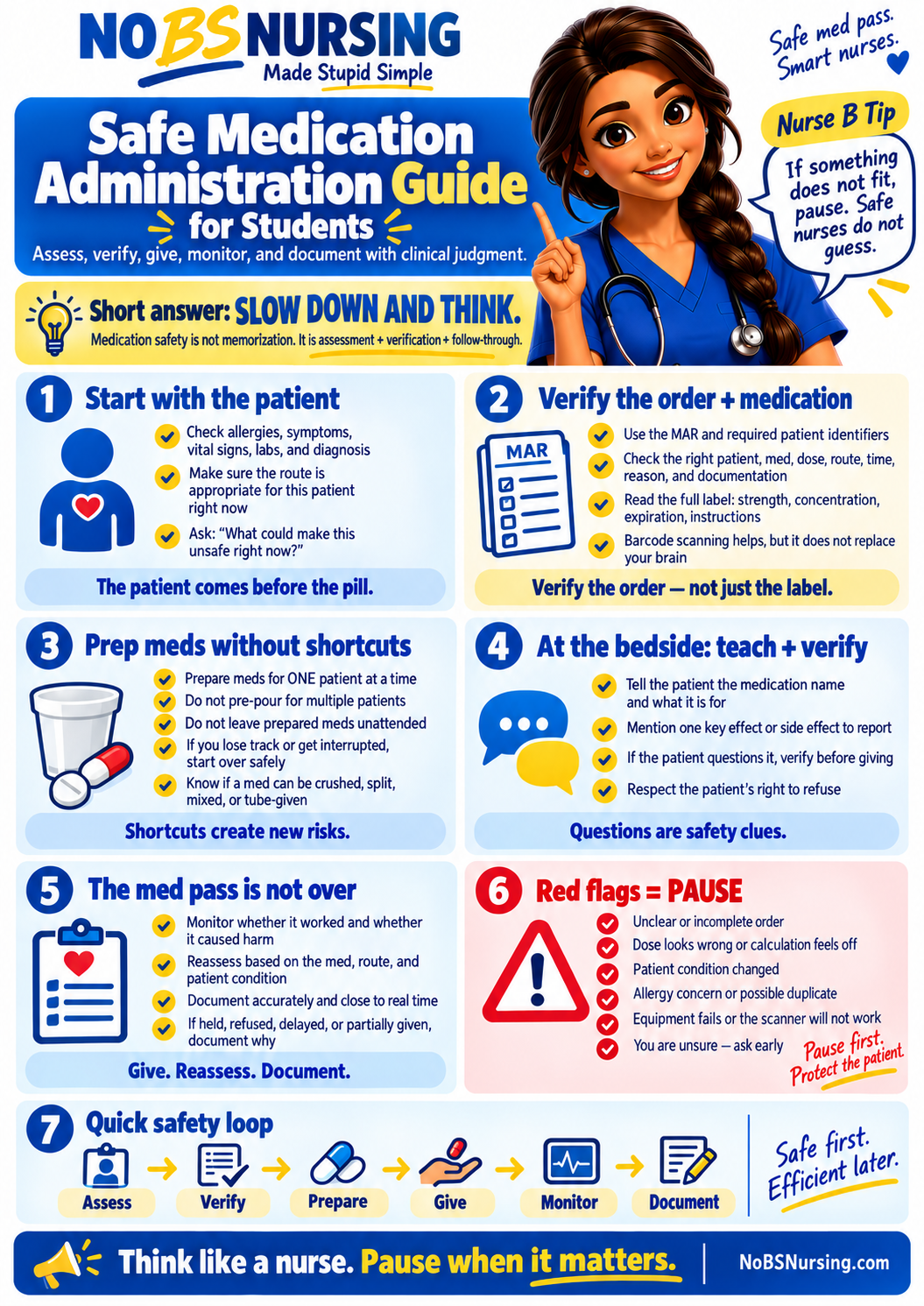
Safe Medication Administration Guide: Start With the Patient
Before you touch the medication drawer, look at the patient. A medication order is not an automatic command. It is a planned intervention that must make sense for this patient, at this time.
Check the basics that could change whether the medication is appropriate: allergies, current symptoms, vital signs, relevant labs, diagnosis, and the patient’s ability to receive the drug by the ordered route. If you are giving an antihypertensive, blood pressure and pulse may matter. If you are giving insulin, blood glucose, meal timing, and the patient’s intake matter. If you are giving an opioid, pain level, respiratory status, sedation, and oxygenation matter.
Do not memorize isolated “hold parameters” and apply them blindly. Follow the medication order, facility policy, and instructions from your instructor or supervising nurse. A heart rate of 58 may be expected for one patient and unsafe for another. The number is a clue. The patient is the reason you assess.
Ask: What could make this medication unsafe right now?
That one question changes everything. A patient who is newly confused may not safely swallow oral medications. A patient with active bleeding needs a closer look before an anticoagulant is given. A patient who is increasingly drowsy after repeated opioid doses needs reassessment, not another dose on autopilot.
If your assessment raises a concern, pause. Do not try to solve uncertainty by guessing. Compare what you found with the order and medication information, then bring a clear concern to your instructor, preceptor, or nurse. Safe nurses escalate early.
Verify the Order and the Medication, Not Just the Label
The classic medication rights are useful, but they are not magic words. Think of them as checkpoints: right patient, medication, dose, route, time, documentation, reason, response, and education. Your program or clinical site may use a different number of rights. The point is the same: each check should answer a real safety question.
Use the medication administration record, or MAR, as your source for what is ordered. Confirm the patient with the required identifiers according to facility policy, typically at the bedside. Compare the medication package with the MAR every time your process requires it, including when you remove the medication, prepare it, and administer it. Barcode scanning helps catch errors, but it does not replace your eyes or your brain.
Read the entire label. Pay attention to the drug name, strength, concentration, route, expiration date, and special instructions. Confusing 10 mg/mL with 10 mg total can turn a simple dose into a dangerous one. Be especially alert with look-alike or sound-alike names, unfamiliar formulations, and medications that have both immediate-release and extended-release versions.
If the order is unclear, incomplete, or does not match the medication available, stop and clarify it through the proper chain. Never “fix” an order yourself. Never borrow a medication from another patient’s drawer. Never assume that a dose is correct because it appears in the MAR.
Calculations deserve a separate safety pause
For a calculated dose, do the math before preparing the medication. Then ask whether the answer makes clinical sense. If a pediatric dose, insulin dose, heparin dose, or IV infusion rate looks wildly different from what you expected, treat that discomfort as a safety signal.
Follow your school and facility process for independent double-checks, particularly for high-alert medications such as insulin, anticoagulants, opioids, concentrated electrolytes, and certain IV medications. An independent double-check means the second person performs their own verification. It is not asking someone to glance at your answer and say, “Looks good.”
Prepare Medications Without Creating New Risks
Preparation is where shortcuts multiply. Avoid them.
Prepare medications for one patient at a time. Keep the medication packages with you until you are at the bedside and ready to administer, unless your facility policy directs otherwise. Do not pre-pour medications for multiple patients. Do not leave prepared medications unattended. If you lose track of a medication, get interrupted at a critical step, or cannot identify what is in a cup or syringe, do not guess. Dispose of it according to policy and start again.
Know whether the medication can be crushed, split, mixed, or given through a feeding tube. Extended-release, enteric-coated, sublingual, and hazardous medications often have special handling requirements. “The patient cannot swallow it” is not a reason to crush it. It is a reason to pause and find the safe alternative.
For injections, verify the correct route, site, needle selection, volume, and technique. Rotate sites when appropriate and assess the skin. For IV medications, check compatibility, dilution requirements, infusion rate, line patency, and whether the patient has a reaction history. These details are not picky nursing-school trivia. They prevent harm.
At the Bedside, Teach and Verify
Bring the patient into the process. State the medication name, what it is for, and a key effect or side effect they should report. Keep the explanation plain. “This is furosemide, a water pill. It can make you urinate more, and I want you to call for help before getting up if you feel dizzy.”
If the patient questions a medication, do not brush it off because the MAR says it is due. Their question may uncover an allergy, a recent medication change, a duplicate dose, or simply a need for teaching. Verify before you administer.
Respect the patient’s right to refuse. First, find out why. They may be nauseated, afraid of a side effect, unable to swallow, or confused about the purpose. Provide appropriate education, but do not pressure them. Follow your facility’s process for documenting the refusal and notifying the nurse or provider when indicated.
Monitor the Response: The Med Pass Is Not Over
Giving the medication is not the finish line. You need to know whether it worked and whether it caused harm.
The timing of your reassessment depends on the medication, route, patient condition, and clinical setting. After an IV opioid, you may need close respiratory and sedation monitoring. After insulin, you need to anticipate glucose changes and hypoglycemia risk. After an antihypertensive or diuretic, reassess the relevant vital signs, symptoms, intake and output, or lab trends as appropriate.
Document accurately and as close to real time as possible, following facility policy. Chart what you gave, when, by which route, and the assessment or response required for that medication. Do not chart before the medication is actually administered. If it was held, refused, delayed, or partially given, document what happened and the reason according to policy.
When you recognize an error or near miss, protect the patient first. Assess, notify the appropriate nurse or provider immediately, and follow your organization’s reporting process. Do not hide it. Reporting is not about punishment. It is how teams identify broken systems and prevent the next error.
Use Clinical Judgment When the Situation Changes
Picture this: You are preparing to give metoprolol. The order includes a parameter to hold the dose if the heart rate is below 60. Your patient’s heart rate is 58, and they say they feel lightheaded when standing. The unsafe move is giving it because it is scheduled. The next safe move is to pause, reassess relevant vital signs and symptoms, hold the medication based on the order, and report your findings to your instructor or nurse.
Now change one detail. The patient’s heart rate is 58, but there is no hold parameter, they are asymptomatic, and their baseline has been in the high 50s. You still do not make up your own rule. You assess, review the order and clinical context, then ask for guidance before administering. Same number. Different situation. That is nursing judgment.
Practice this thought process every time: What am I giving? Why does this patient need it? What must I assess first? What could go wrong? What will I monitor afterward? When you can answer those questions, you are not just memorizing medication cards. You are thinking like a nurse.